

Safety Sheet and Label information:
Safety information resources :
Australian Workcover NSW website address
ANSI/NFPA 704 hazard label system:
For further reference – NFPA CHEMICAL HAZARD LABELS USA National Fire Protection Association
NFPA 704: Standard System for the Identification of the Hazards of Materials for Emergency Response
NFPA 497: Recommended Practice for the Classification of Flammable Liquids, Gases, or Vapors and of Hazardous (Classified) Locations for Electrical Installations in Chemical Process Areas
NFPA 499: Recommended Practice for the Classification of Combustible Dusts and of Hazardous (Classified) Locations for Electrical Installations in Chemical Process Areas
For further reference about NFPA 704 – http://en.wikipedia.org/wiki/NFPA_704
For further reference about hazard symbols – http://en.wikipedia.org/wiki/Hazard_symbol
Examples of Visual Labels:
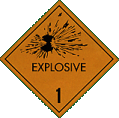 Class 1 Explosives (eg: Gelatine, Dynamite)
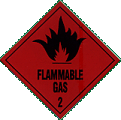 Class 2.1 Flammable Gases (eg: Lpg gas)
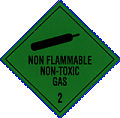 Class 2.2 Non-flammable Non-toxic Gases (eg: Nitrogen compressed)
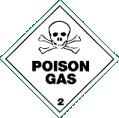 Class 2.3 Poison Gases (eg: Chlorine gas)
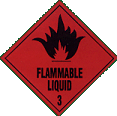 Class 3 Flammable Liquids (eg: Petrol, Methanol, Ethanol)
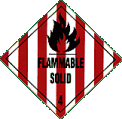 Class 4.1 Flammable Solids (eg: Nitrocellulose, Hexamine)
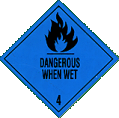 Class 4.3 Flammable Substances if Wetted (eg: Calcium Carbide)
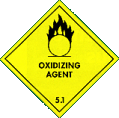 Class 5.1 OxidizingSubstancess (eg: Nitrates- potassium nitrate, potassium chlorate)
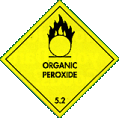 Class 5.2 Organic Peroxides (eg: M.E.K.P.)
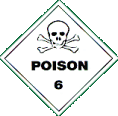 Class 6.1(a) Poisonous Substances (eg: Cyanides)
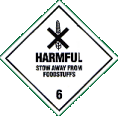 Class 6.1(b) Harmful Substances (eg: Cadmium Compounds, Formaldehyde)
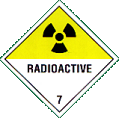 Class 7 Radioactive Substances (Prescribed by Radioactive Substances act 1967)
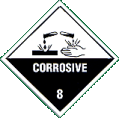 Class 8 Corrosive Substances (eg: Sulphuric Acid, sodium hydroxde – (nearly all acids and alkali’s))
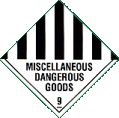 Class 9 Miscellaneous Substances (eg: Dry ice, Fishmeal, Aerosols) Mixed Class Transport Diamond